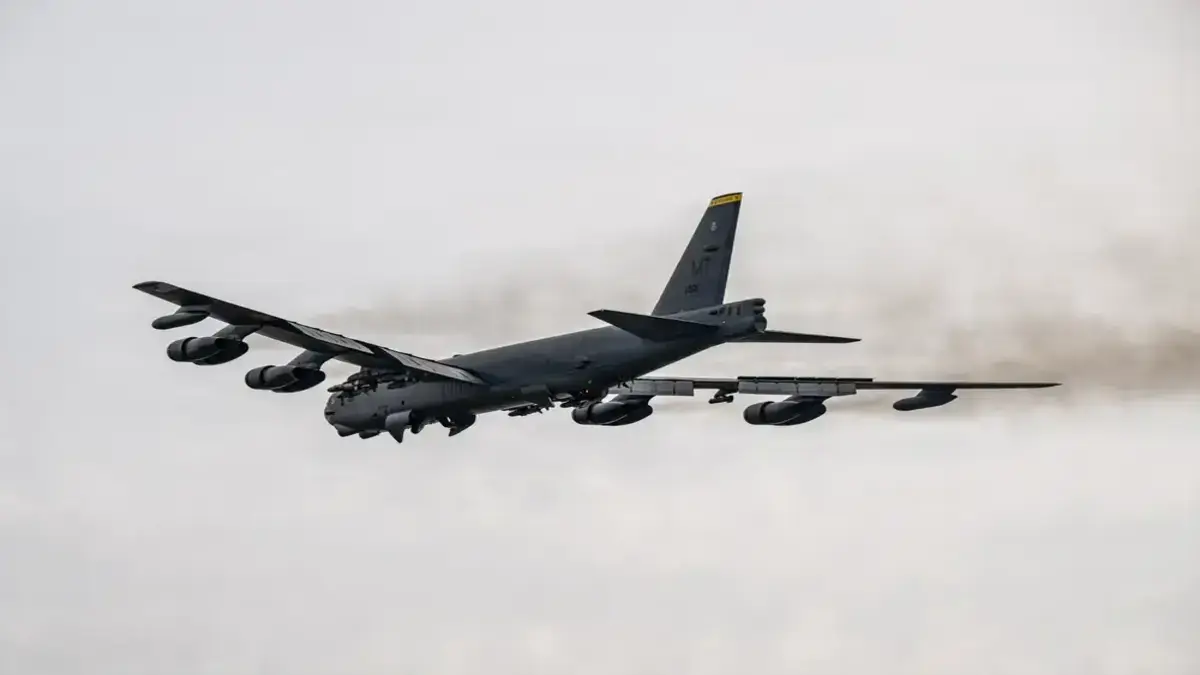
In a stunning revelation amid escalating tensions, America’s top military leader has confirmed that US air superiority over Iran has unlocked unprecedented capabilities for the legendary B-52 Stratofortress. After more than a month of relentless operations, coalition forces have neutralized key threats, allowing these massive bombers to fly bold overland routes deep into hostile territory. This development marks a critical turning point, showcasing how dominance in the skies is reshaping the battlefield dynamics.
Air Force General Dan Caine, serving as Chairman of the Joint Chiefs of Staff, delivered this update during a high-stakes press briefing. His comments highlight the precision and persistence that have crippled Iran’s defenses, opening pathways for strategic heavy bombers. As the conflict intensifies, the B-52’s resurgence underscores the enduring might of U.S. air power.
Achieving Air Superiority: The Foundation of Victory
From the outset, U.S. and allied forces focused on shattering Iran’s layered air defense architecture. Surgical strikes hammered radars, surface-to-air missile batteries, and centralized command nodes stretching from Tehran to remote outposts. This methodical campaign has carved out secure airways, minimizing risks for follow-on missions.
General Caine detailed how, in just 30 days, strikes have neutralized over 11,000 targets. Beyond traditional explosives, these efforts integrated cyber intrusions, satellite intelligence, and sophisticated electronic warfare to paralyze enemy detection systems. The result? Iranian sensors are effectively sightless, and communication lines severed.
Past actions, such as Israeli airstrikes and the audacious Operation Midnight Hammer last summer, eroded these defenses incrementally. Now, the synergy of these operations grants U.S. and Israeli aircraft virtual uncontested access across Iranian airspace.
- Primary strike priorities: Radar arrays and missile silos
- Advanced enablers: Cyber attacks, orbital reconnaissance, signal jamming
- Battlefield payoff: Unrestricted maneuverability for bombers and fighters
This air dominance isn’t just tactical—it’s a psychological blow, forcing Iran to divert resources from ground offensives to futile skyward defenses.
The Legendary B-52 Stratofortress: A Timeless Arsenal
The B-52 Stratofortress, crafted by Boeing, stands as an icon of American aviation resilience. Operational for more than seven decades since its 1950s debut, it outshines flashier successors in sheer endurance and cargo capacity. Though lacking the agility of the B-1 or the invisibility of the B-2, its bomb bay can unleash devastation unmatched in volume.
The U.S. Air Force fields 72 operational B-52s today, with a roadmap extending service life to 2050. Certain models retain nuclear strike options, while most excel in conventional roles, from carpet bombing to precision-guided munitions.
Proven in Fire: A Rich Combat Legacy
The B-52’s chrome-domed silhouette has pierced hostile skies from Vietnam to Iraq, adapting through eras of technological leaps. Its fortified structure withstands extreme altitudes and payloads, ensuring reliability under duress. Surplus airframes await in Arizona’s aircraft graveyard, ready for reactivation if needed.
In current Middle East theaters, B-52s operate shoulder-to-shoulder with newer platforms, proving that experience trumps novelty in sustained campaigns.
Overland Breakthrough: Redefining Bomber Tactics
Historically cautious over enemy territory, B-52s now soar overland thanks to cleared skies. This evolution permits intimate target proximity, amplifying strike accuracy and response times. General Caine stressed this as a force multiplier, sustaining relentless pressure on Iranian assets.
Cruising above weather layers, these behemoths drop ordnance with surgical intent, all while evading remnants of defenses. It’s a testament to how air control liberates even venerable assets for frontline daring.
Modernization Marvels: Keeping the B-52 Ahead of the Curve
To propel the B-52 into the 22nd century, the Air Force is pouring resources into transformative upgrades. These address wear from decades of service, fortifying it against next-gen threats like hypersonic missiles and AI-driven countermeasures.
Central to this is the Commercial Engine Replacement Program (CERP), replacing antiquated powerplants with state-of-the-art commercial derivatives ruggedized for combat. Expect surges in efficiency, range, and uptime.
Powerplant Revolution: Details and Deliverables
Boeing clinched a pivotal $2 billion deal in December to accelerate CERP rollout, overcoming prior funding snags. Fresh engines slash fuel thirst and overhaul intervals, ideal for marathon sorties over Iran.
- Core advantages: Enhanced power output, slashed lifecycle expenses
- Deployment schedule: Gaining speed after contract award
- Long-haul value: Viable fleet through 2050 and beyond
Radar Renaissance: Sharper Eyes in the Sky
Complementing engines, the Radar Modernization Program installs active electronically scanned arrays (AESA). These radars boast panoramic surveillance, anti-jam resilience, and integration with networked warfare tools.
Despite budgetary hurdles, progress accelerates—a prototype B-52 logged its inaugural radar-equipped flight last December. This fusion of heritage airframe and bleeding-edge avionics cements the B-52’s supremacy.
These investments don’t just patch flaws; they evolve the Stratofortress into a hybrid of yesterday’s reliability and tomorrow’s lethality.
Broader Ramifications: Reshaping the US-Iran Standoff
Overland B-52 forays signal operational zenith after air supremacy consolidation. U.S. forces now orchestrate round-the-clock barrages, eroding Iran’s war machine from command bunkers to supply depots.
This aerial leash deters escalation, compelling Tehran to rethink aggression amid mounting losses. Seamless U.S.-Israeli teamwork magnifies impacts, tilting power balances across the Middle East.
Surpassing one month, the war reveals the B-52’s chameleon-like versatility. Revitalized legacies eclipse projections, blending mass firepower with pinpoint execution.
In essence, US air superiority over Iran has catalyzed a bomber renaissance, with the B-52 Stratofortress at the vanguard. Modernizations guarantee its throne in America’s arsenal, fortifying deterrence worldwide. From suppression to supremacy, this saga affirms strategic foresight’s triumph in aerial warfare.